Tuggerah, NSW  ·  Community Information

Powering the Grid.
Quietly. Safely.
Right Here.

The Lake Road Battery Energy Storage System is large-scale clean energy infrastructure located at 77 Lake Road, Tuggerah. This page answers your questions and explains what the project means — and doesn't mean — for the local community.

See our answers to your questions →
1,600MWh
Storage Capacity
400MW
Export Power
25yr
Project Lifespan

What is the Lake Road Battery Project?

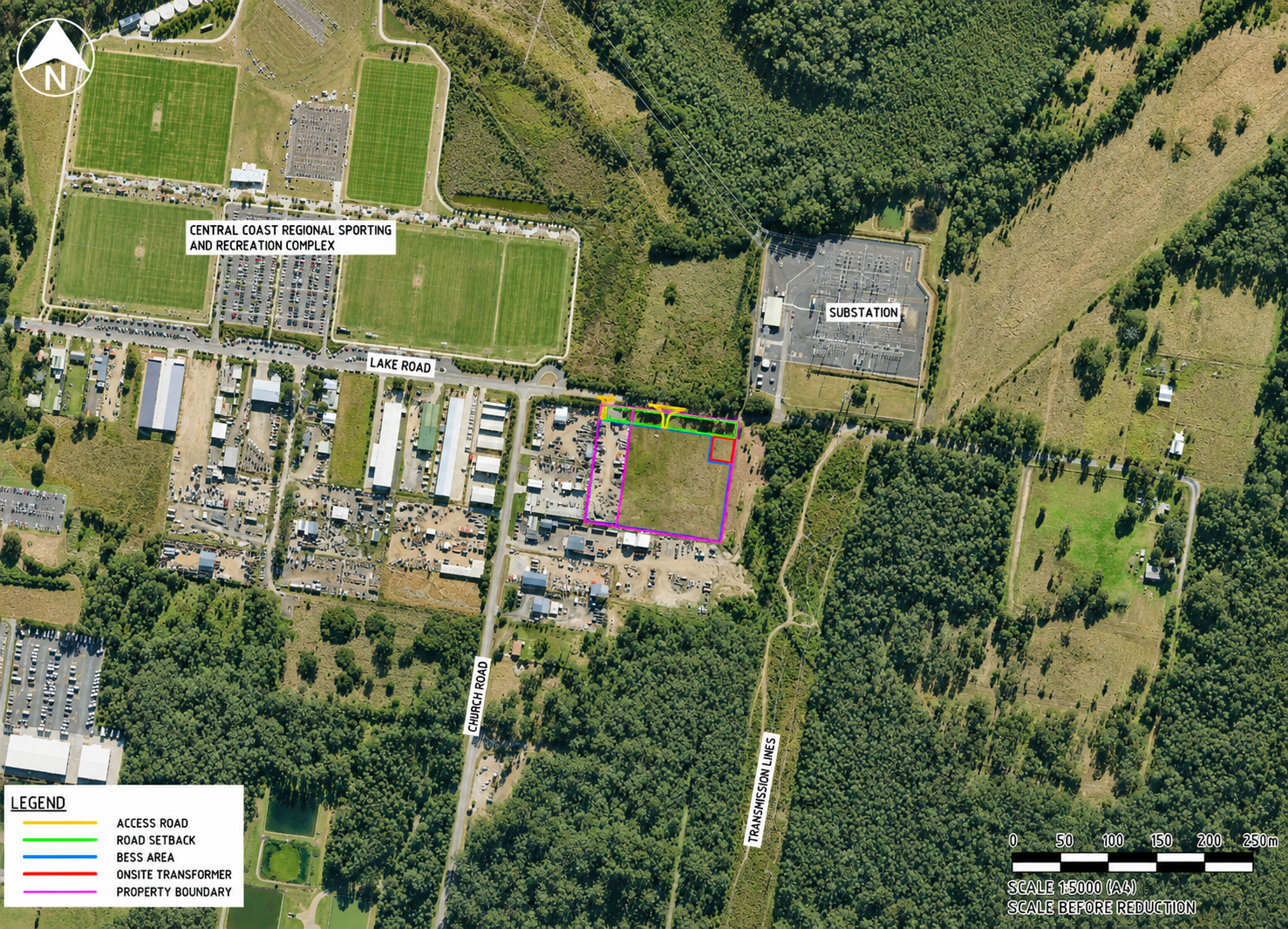
The Lake Road Battery Energy Storage System (BESS) is a large-scale electricity storage facility located at 77 Lake Road, Tuggerah. It is connected to the Transgrid high-voltage transmission network at Tuggerah Substation.

Battery storage projects like this one store surplus renewable electricity from the grid and release it when it is needed most — helping to keep power prices stable, preventing blackouts, and supporting the transition to clean energy across NSW.

The site is a clean, quiet infrastructure facility. It does not involve fossil fuels, combustion, or any industrial process that produces emissions, odours, or noise perceptible to nearby residents.

  • 📍
    Location77 Lake Road, Tuggerah NSW 2259
  • TechnologySungrow Power Titan 3.0 lithium iron phosphate (LFP) battery systems
  • 🔗
    Grid ConnectionConnected to Transgrid's 132kV transmission network at Tuggerah Substation
  • 🏗️
    DeveloperLake Road Battery Company, with engineering support from Axcentium
  • 📅
    Project StatusDevelopment and grid connection approvals in progress

Site location — 77 Lake Road, Tuggerah NSW 2259

Your questions,
answered honestly.

We know that any new infrastructure project raises questions. Here is our plain-language response to the concerns we hear most often from the community.

🔥

Fire Safety

Battery fires receive significant media coverage — and it is right to ask. The technology we use — lithium iron phosphate (LFP) chemistry — is the most thermally stable battery chemistry commercially available. Our systems include multi-layer fire detection and suppression built into every battery cabinet, continuous remote monitoring, and an on-site fire management plan developed with NSW Fire & Rescue. The design principle is strict containment: any incident is managed within the affected cabinet and cannot propagate to adjacent units or off-site.

Risk is low and rigorously managed
🔊

Noise

Battery storage systems are not noisy. The primary sound source is the cooling fans on the inverter and battery cabinets — operating at levels comparable to a residential air conditioning unit. The facility sits within an industrial zone, well-separated from residential areas. A professional acoustic assessment has been conducted confirming compliance with NSW EPA noise guidelines. There are no generators, combustion engines, or processes that produce impact or tonal noise.

Noise levels within EPA guidelines
👁️

Visual Impact

The battery cabinets and associated equipment are low-profile, modular structures — typically 2–3 metres in height. The site is screened by perimeter fencing and landscaping. There are no tall chimneys, cooling towers, flares, crane structures, or any other prominent industrial feature. At night, only standard low-level security lighting is used — there are no floodlit compounds or flashing warning lights visible from surrounding areas.

Low-profile, screened site
🏡

Impact on Daily Life

Once operational, the facility runs silently and automatically around the clock, managed remotely from a control centre. Only occasional maintenance visits during business hours are required — typically a few visits per month from a small crew. There is no continuous vehicular traffic, no industrial shift workers arriving and departing, and no odour or emissions of any kind. The project will not affect local roads, services, or community amenity in any meaningful way during normal operation.

No material impact on residents
🌿

Environment

The project produces zero operational emissions. LFP batteries do not contain cobalt or other environmentally hazardous materials found in older lithium battery chemistries. End-of-life battery recycling obligations are addressed in our environmental management plan in accordance with NSW regulations. The project has been assessed and approved under the NSW planning framework, including environmental impact assessment requirements.

Zero operational emissions
💰

Property Values

Battery storage facilities are clean, quiet infrastructure — more comparable to a data centre or electrical substation than a traditional industrial facility. Academic and industry research does not support the claim that well-managed battery projects negatively impact nearby residential property values, particularly when sited within established industrial or commercial zones, as is the case here.

No evidence of property value impact

From sunlight to your switch

Battery storage is a critical piece of infrastructure for a modern electricity grid. Here is how our facility fits into the system.

☀️
Step 1 · Charging

Renewable energy enters the grid

Solar farms and wind turbines across NSW generate electricity — often producing more than is needed in real time. This surplus pushes prices down on the wholesale electricity market, and without storage, much of it is simply wasted.

🔋
Step 2 · Storage

We store that energy at Tuggerah

Our 1,600 MWh of battery capacity charges from the grid when electricity is cheap and abundant — absorbing renewable energy that would otherwise be curtailed. The facility is connected directly to the Transgrid high-voltage transmission network.

Step 3 · Dispatch

We release it when the grid needs it

During peak demand — typically early evenings, or during extreme weather events — we discharge rapidly into the Transgrid network, stabilising frequency, supporting voltage, and reducing the risk of widespread outages.

🏠
Step 4 · Benefit

Homes and businesses benefit

More grid stability means lower wholesale price spikes during peak periods, less reliance on expensive gas peaking plants, and a more reliable electricity supply for homes and businesses across the Central Coast and beyond.

Built on proven, safe technology

The facility uses Sungrow's Power Titan 3.0 battery system — a commercially proven, utility-scale platform deployed in battery projects around the world. Each unit is a fully integrated cabinet containing batteries, inverter, thermal management, and fire suppression in a single factory-tested enclosure.

We have specifically selected lithium iron phosphate (LFP) chemistry. Unlike the NMC or NCA chemistries found in consumer electronics and some electric vehicles, LFP does not undergo the same thermal runaway reactions that lead to uncontrolled fires. It is the chemistry of choice for large-scale stationary storage precisely because of its superior safety profile and long operational life.

✓   Lithium iron phosphate (LFP) — the safest lithium battery chemistry

Project Technical Overview

Total storage capacity1,600 MWh
Maximum export power400 MW
Grid connection voltage132 kV
Network operatorTransgrid
Battery chemistryLFP (lithium iron phosphate)
Inverter technologySungrow Power Titan 3.0
Site areaTo be confirmed
Design operational life25 years
Operational emissionsZero

Common questions

If your question isn't covered here, please contact us directly — we will respond within 3 business days.

Construction activity will be confined to the industrial site at 77 Lake Road and will use the primary Lake Road access route. All construction hours will comply with standard NSW EPA noise and hours guidelines. Once the facility is operational, it requires only occasional maintenance visits — typically a small number of vehicles per month during normal business hours.
Our battery cabinets use lithium iron phosphate (LFP) chemistry, which is substantially more resistant to thermal runaway than the NMC or NCA lithium chemistries found in consumer electronics. Each cabinet has integrated gas detection, fire detection, and an active suppression system that activates automatically. Our Emergency Response Plan has been developed in consultation with NSW Fire & Rescue. The core design principle is containment: if a fault were to occur in any cabinet, it would be isolated and suppressed within that unit and would not propagate to adjacent cabinets or to areas outside the site boundary.
No. Battery storage facilities produce no ionising radiation and are not classified as a radiation source of any kind. Electromagnetic fields (EMF) at the site perimeter are consistent with those near any standard electrical infrastructure — such as a substation or high-voltage powerline — and are well within ARPANSA (Australian Radiation Protection and Nuclear Safety Agency) guidelines. The facility is not a telecommunications installation and has no relationship to mobile networks or 5G technology.
The project is designed with a 25-year operational life. After that period, the batteries will be decommissioned and recycled in accordance with applicable NSW regulations and our environmental management obligations. The site would then be remediated as required under our planning approval conditions.
The project is subject to the NSW planning approvals process, which includes formal public exhibition and an opportunity for community submissions. Grid connection is approved by Transgrid as the Transmission Network Service Provider, subject to technical studies and compliance requirements. Relevant environmental, acoustic, and technical assessments are completed as part of these processes. We are committed to full compliance with all conditions of approval and to engaging openly with the community throughout.
The facility connects to the high-voltage Transgrid transmission network, not to the local distribution network that serves homes and businesses in Tuggerah. Its operation will not affect your household electricity supply or cause localised outages. The facility's role in the electricity market is specifically to improve overall grid stability and reduce the likelihood of system-wide stress events — it is part of the solution to blackout risk, not a cause of it.
No. Battery energy storage systems produce zero operational emissions and no odour. There is no combustion, no fuel storage, no chemical processing, and no industrial exhaust. The only operational output from the site is electrical energy delivered to the transmission network.
During any formal public exhibition period under the NSW planning process, submissions can be made directly to the NSW Department of Planning, Housing and Infrastructure. Details of the exhibition period, project reference number, and submission portal will be posted on this page and on the Department's website when available. We also welcome direct feedback via our community contact email at any time.

Transparency & documentation

Key project documents will be made available here as they are completed and approved for public release.

Documents will be linked here as they become available. Contact us if you require a specific document sooner.

We want to hear from you.

We are committed to being open, transparent, and responsive throughout the life of this project. If you have a question or concern not covered here, please get in touch.

Contact the project team

Our team is available to answer questions from local residents, community groups, and other stakeholders. We aim to respond to all enquiries within 3 business days.

community@lakeroad.com.au →
Lake Road Battery Company
77 Lake Road
Tuggerah NSW 2259

What this project means for the region

  • Investment in the Central Coast economy during construction and operation
  • Clean energy infrastructure supporting NSW grid reliability and stability
  • Local employment during the construction phase
  • Long-term support for renewable energy integration across the NEM
  • Reducing reliance on costly gas peaking generation during high-demand periods
  • Demonstrating that clean energy assets can be good industrial neighbours